Azure, Azure Pipelines, DevOps, Security

Create Issues in Azure DevOps via Snyk API

Snyk is a great tool for scanning your code and containers for vulnerabilities. Snyk is constantly evolving and adding new features and integrations so if you haven’t checked out the Snyk website, I highly recommend you do so. There also is a free tier for you to get started.

One of the features is Jira Integration, this allows you to create a Jira Issue from within Snyk. If you use Jira then I can see a benefit for this but what if you use Azure DevOps or you want to automate the issue creation.

This post goes though using an Azure Logic App to create an issue in Azure DevOps when a new issue is discovered (Note: the process works for Jira too, just use the Azure Logic App Jira connector).

To use the Snyk API you will need to be on the Business Plan or above (at the time of writing), this then allows the ability to add a webhook to receive events.


So the flow of the Logic App is something like this

On enable of the Logic App it will register as a webhook with your Snyk account and on disable will unregister the webhook.

Let’s build the logic app, step one create a new Logic App in Azure

Once that has been created, select a blank logic app and find the HTTP Webhook trigger

As detailed in the Snyk API Documentation set the subscribe method to POST and the URI for web hooks with your organization Id (this can be found on your Snyk account under Org Settings -> General)

Add the subscribe body that includes a secret defined by you and the url of the logic app (for the URL select the Callback Url in dynamic content)

Now set the unsubscribe method to DELETE and use an expression for the URI and leave the Body as blank

concat('https://snyk.io/api/v1/org/<your org id>/webhooks/',triggerOutputs().subscribe.body.id)

Now add new parameters for Subscribe – Headers and Unsubscribe – Headers

Authorization in both headers should be set to your API token (this can be found on your Snyk account Account Settings -> API Token)

When registering the application Snyk sends a Ping event which is determined by the X-Snyk-Event header, we really don’t want to run the rest of the workflow when this happens so we can add a condition to terminate

Select New Step then find Control and select it

Then select Condition
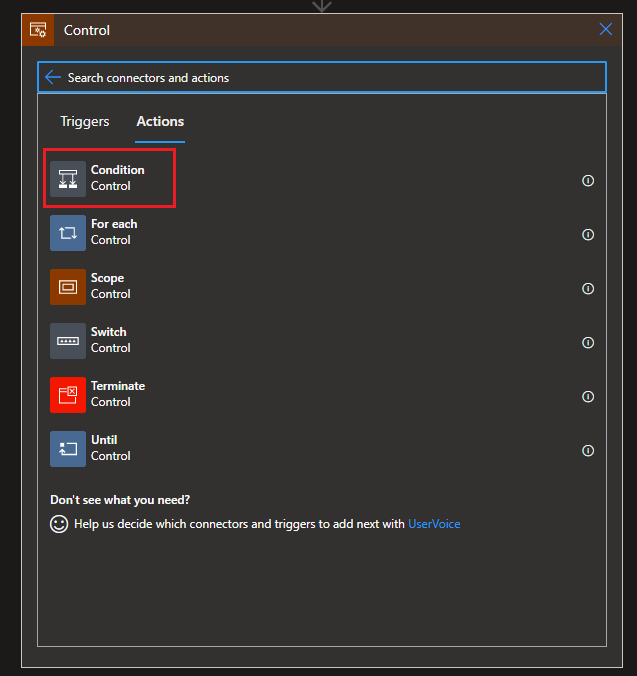
For the value use an expression to get the X-Snyk-Event header

@triggerOutputs()?['headers']?['X-Snyk-Event']

and then make the condition check it contains the word ping (the actual value is ping and the version e.g. ping/v0)

Now in the True side add an action to Terminate and Set it to Cancelled

Now if the message is anything other than a ping then we want to continue processing the response. We will want to validate that the message coming in is from Snyk and is intended for us as it will have created a signature using our custom secret and added to the header under X-Hub-Signature. To perform this validation we can use an Azure Function.

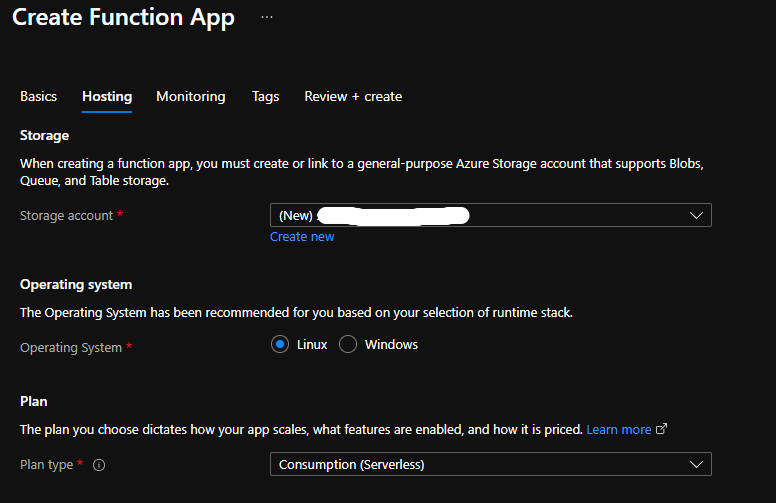
You can create an Azure Function via the Portal, I suggest you use Linux as the OS

Using Visual Studio Code with the Functions Runtime installed you can create and deploy the following function. If you are not sure how to do this take a look at the Microsoft Docs they are really helpful

I named the function ValidateRequest and used some code from the Snyk API documentation to perform the validation and return either OK (200) or Bad Request (400)

const crypto = require('crypto');
module.exports = async function (context, req) {
     
    context.log('JavaScript HTTP trigger function processed a request.');
    const secret = req.headers['x-logicapp-secret'];
    const hubsignature = req.headers['x-hub-signature'];
    const hmac = crypto.createHmac('sha256', secret);
    const buffer = JSON.stringify(req.body);
    hmac.update(buffer, 'utf8');
    const signature = `sha256=${hmac.digest('hex')}`;    
    const isValid = signature === hubsignature;
   
    context.res = {
        status: isValid ? 200 : 400,
        body: isValid
    };    
}

Now the Function is deployed we can add the next step to the Logic App.

Select the function app we created previously
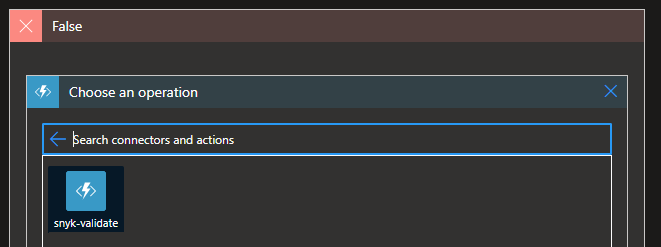
And select the function we deployed previously

Now we need to pass the payload from the webhook into our ValidateRequest function

Add additional parameters for method and header

Set the method to POST and switch the headers to text mode
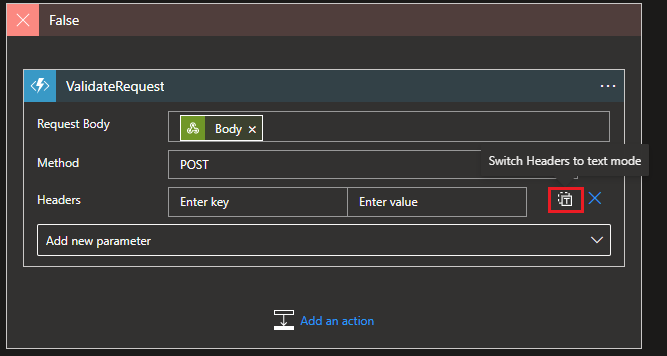
Then add the following expression to add the request headers and one with your secret

addProperty(triggerOutputs()['headers'], 'X-LogicApp-Secret', '<your secret>')

If the check is successful then the next step is to parse the json and loop through the new issues

For the Content add the payload as you did previously for the validate functionand the Schema add the following

{
    "properties": {
        "group": {
            "properties": {},
            "type": "object"
        },
        "newIssues": {
            "type": "array"
        },
        "org": {
            "properties": {},
            "type": "object"
        },
        "project": {
            "properties": {},
            "type": "object"
        },
        "removedIssues": {
            "type": "array"
        }
    },
    "type": "object"
}

Next we need to loop through the new issues, add a new action using the control For each and add newIssues

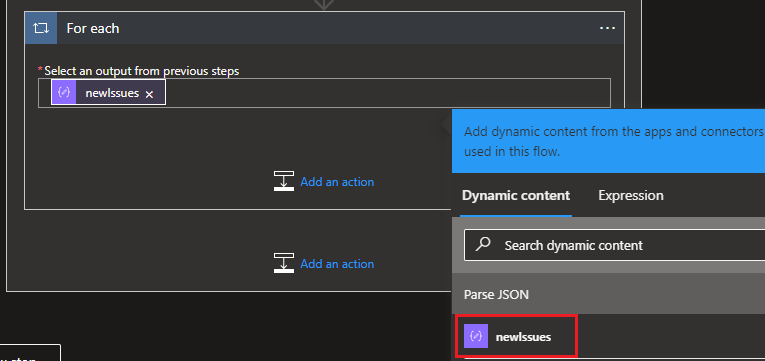
For this I am only interested in the high severity issues so we need to add another condition using an expression for the value and is equal to high (Note: I renamed the condition to Severity)

items('For_each')?['issueData']?['severity']

Now if the severity is high then create work item using the built-in Azure DevOps connector

This will ask you to sign in

Once signed in you can set the details of the Azure DevOps organization, project and work item type

To add the details from the issue as the title and description use the following expressions

items('For_each')?['issueData']?['title']
items('For_each')?['issueData']?['description']

And that is the Logic App complete, a created work item with the title and description fields from the payload looks like this

Perhaps the formatting could do with some work but the information is there and the workflow works.

Although I used Azure DevOps as the output, there is a Jira connector that will allow creation of an issue in Jira

Once you are happy everything is running there is one last step, securing the secrets inside the logic app so they can only be seen by the designer

For the webhook select the settings and turn on Secure Inputs and Secure Outputs

and for the ValidateRequest function turn on at least Secure Inputs.

I find Azure Logic Apps a great way to connect systems together for these types of workflows because it has so many connectors.

NOTE: If you run the logic app via Run Trigger it will fail when looking for the X-Snyk-Event header. Disable and Enable the logic app to register the connection with the API

I hope it helps others integrate Snyk with their workflows and can’t wait to see what other features the API will provide in the future.

Architecture, Azure Pipelines, Diagrams

Azure Pipelines – Diagrams as Code

Following on from my previous post on Architecture Diagrams I thought I would share my experiences with another tool, Diagrams.

Diagrams uses the Python language to describe diagrams, Python is not a language I use generally but it was simple enough to learn building diagrams.

The documentation describes how to get started and setup. I am a big fan of containers and so I created a container for using Diagrams.

The following dockerfile will create an environment:

FROM python:alpine3.13
ENV APK_ADD "bash py3-pip graphviz ttf-freefont"

RUN apk upgrade --update && \
    apk add --no-cache --virtual .pipeline-deps readline linux-pam && \
    apk add --no-cache ${APK_ADD} && \
    # Install Diagrams
    pip --no-cache-dir install --upgrade pip && \
    pip --no-cache-dir install diagrams && \
    # Tidy up
    apk del .pipeline-deps

RUN echo "PS1='\n\[\033[01;35m\][\[\033[0m\]Diagrams\[\033[01;35m\]]\[\033[0m\]\n\[\033[01;35m\][\[\033[0m\]\[\033[01;32m\]\w\[\033[0m\]\[\033[01;35m\]]\[\033[0m\]\n \[\033[01;33m\]->\[\033[0m\] '" >> ~/.bashrc

CMD tail -f /dev/null

To build and run: (I used a windows 10 machine)

docker build -f diagrams.dockerfile -t my-diagrams
docker run -it --entrypoint=/bin/bash --volume $env:USERPROFILE\source\repos:/mycode my-diagrams

Diagram

With my new environment I can use an editor of my choice to create the diagrams, my current go to is Visual Studio Code and there is a extension for Python.

The purpose of using this tool was to draw a diagram of an Azure Tenant and Subscription setup, I needed something that would allow the diagram to be changed quickly as the multiple people were collaborating.

The code below shows a simple example of the diagram being created:

from diagrams import Cluster, Diagram
from diagrams.azure.general import Managementgroups
from diagrams.azure.general import Subscriptions
from diagrams.azure.identity import ActiveDirectory

with Diagram("Azure Tenant Design", show=False, direction="TB"):
    tenant = ActiveDirectory("Tenant AD")  
    topGroup = Managementgroups("Main\r\nManagement Group")
    sandbox = Subscriptions("Sandbox\r\nSubscription")

    with Cluster("Business Units"):
        with Cluster("Unit1"):
          mainGroup = Managementgroups("Unit1\r\nManagement Group")
          topGroup >> mainGroup
          with Cluster("Project1"):
            group = Managementgroups("Project1\r\nManagement Group")
            sub = [Subscriptions("Project1\r\nDev/Test\r\nSubscription"), Subscriptions("Project1\r\nProduction\r\nSubscription")]
            group - sub
            mainGroup >> group

          with Cluster("Project2"):
            group = Managementgroups("Project2\r\nManagement Group")
            sub = [Subscriptions("Project2\r\nDev/Test\r\nSubscription"), Subscriptions("Project2\r\nProduction\r\nSubscription")]
            group - sub
            mainGroup >> group

        with Cluster("Infrastructure"):
          group = Managementgroups("Infrastructure\r\nManagement Group")
          sub = [Subscriptions("Test\r\nSubscription"), Subscriptions("Infrastructure\r\nProduction\r\nSubscription")]
          group - sub
          topGroup >> group

    tenant >> topGroup >> sandbox

The diagram can be created by simply calling python and the name of the file (this code was executed from the container).

The code produces the following diagram:

Azure Pipelines

Now the diagram code is created, it would be good to be able to have a pipeline building the diagram and providing the image. Building the diagrams in an Azure Pipeline would be easier if I could use the container created earlier.

Fortunately I can, Azure Pipelines allows container jobs, but that means the dockerfile needs a few modifications to use it in Azure Pipelines. The Microsoft Docs explain in more detail but for this I need node installed, a special label and some additional packages.

The new dockerfile looks like this:

FROM node:lts-alpine3.13 AS node_base

RUN echo "NODE Version:" && node --version
RUN echo "NPM Version:" && npm --version

FROM python:alpine3.13

ENV NODE_HOME /usr/local/bin/node
COPY --from=node_base ["${NODE_HOME}", "${NODE_HOME}"] 

LABEL maintainer="Tazmainiandevil"
LABEL "com.azure.dev.pipelines.agent.handler.node.path"="${NODE_HOME}" 

ENV APK_ADD "bash sudo shadow py3-pip graphviz ttf-freefont"

RUN apk upgrade --update && \
    apk add --no-cache --virtual .pipeline-deps readline linux-pam && \
    apk add --no-cache ${APK_ADD} && \
    # Install Diagrams
    pip --no-cache-dir install --upgrade pip && \
    pip --no-cache-dir install diagrams && \
    # Tidy up
    apk del .pipeline-deps

RUN echo "PS1='\n\[\033[01;35m\][\[\033[0m\]Diagrams\[\033[01;35m\]]\[\033[0m\]\n\[\033[01;35m\][\[\033[0m\]\[\033[01;32m\]\w\[\033[0m\]\[\033[01;35m\]]\[\033[0m\]\n \[\033[01;33m\]->\[\033[0m\] '" >> ~/.bashrc

CMD tail -f /dev/null

Container Build

Using Azure Pipelines I can build the container and added it to an Azure Container Registry (if you need to know how to setup ACR see my previous post on Configuring ACR)

trigger: 
 branches:
    include:
    - main
 paths:
    include: 
     - diagrams.dockerfile

pr: none

variables:
- group: Azure Connections
- name: dockerFilePath
  value: diagrams.dockerfile
- name: imageRepository
  value: dac/diagrams

pool:
  vmImage: "ubuntu-latest"

steps:
  - task: Docker@2
    displayName: "Build Diagram Image"
    inputs:
      containerRegistry: "$(myContainerRegistry)"
      repository: '$(imageRepository)'
      command: 'buildAndPush'
      Dockerfile: '$(dockerfilePath)'
      tags: |
        $(Build.BuildNumber)
        latest

With the container added to my registry I can use it in a pipeline to create my diagrams.

Image Build

The pipeline needs to create an image as an artifact and only when on the main branch to make sure only the final diagrams are published and not ones in progress.

The YAML below defines the pipeline:

trigger: 
   - main

pr: none

variables:
  isMain: $[eq(variables['Build.SourceBranch'], 'refs/heads/main')]

jobs:
- job: creatediagram
  displayName: Create Diagram  
  pool:
    vmImage: ubuntu-latest
  container:
    image: $(myContainerRegistry)/dac/diagrams:latest
    endpoint: 'My Registry Service Connection'
  variables:
    workspaceFolder: 'TenantDesign'
  steps:
  - script: | 
      python tenant.py
      cp *.png $(Build.ArtifactStagingDirectory)
    displayName: Run Python
  - publish: '$(Build.ArtifactStagingDirectory)'
    displayName: Publish Diagrams
    artifact: $(workspaceFolder)
    condition: eq(variables.isMain, true)

Conclusion

I found using Diagrams simple and the documentation was good to allow picking up what was needed quickly. I will certainly be looking at using it for other diagrams in the future. I like the fact that it is easy to use, open source and supports custom images so you are not limited to the provided icons (Custom Docs).

Diagrams GitHub

Diagrams Docs

I hope that others find this useful and use Diagrams as Code for their projects.